
What a quantum computer is not
The most useful place to start is by dismantling the biggest misconception: a quantum computer is not simply a much faster version of the computer on your desk. It will not run your applications quicker, load web pages faster, or replace ordinary computers for everyday tasks. This framing — quantum as "super-fast classical computing" — is wrong in a way that causes most of the public confusion. A quantum computer is a fundamentally different kind of machine, built to do a specific and narrow set of things that classical computers do badly, and it is worse than a classical computer at almost everything else.
Understanding this narrows the technology to its real significance. Quantum computers are not general-purpose replacements; they are specialised tools that, for certain particular problems, can do things no classical computer feasibly could. For the vast majority of computing tasks, a classical computer remains faster, cheaper, and more practical, and will indefinitely. The excitement around quantum computing is justified, but it is justified for a small class of problems, not for computing in general. Keeping that distinction clear immediately deflates most of the hype and reveals what is actually at stake.
The qubit and the strangeness beneath it
The heart of a quantum computer is the qubit, the quantum equivalent of the classical bit. A classical bit is definitively either a zero or a one. A qubit, by contrast, can exist in a state called superposition, which is often described loosely as being "both zero and one at once." That description is not quite right, but it points at something real: a qubit's state is a combination of possibilities, and it is this ability to hold a blend of states, rather than a single definite value, that gives quantum computing its power.
The second key phenomenon is entanglement, in which qubits become linked so that the state of one is bound up with the state of another, even in ways that have no classical analogue. Together, superposition and entanglement allow a quantum computer to represent and manipulate a vast space of possibilities simultaneously in a way classical bits cannot. But there is a crucial catch that the hype ignores: you cannot simply read all those possibilities out. When a qubit is measured, it collapses to a single definite value, and the art of quantum algorithms is arranging the computation so that, when you measure, the answer you want is overwhelmingly likely to emerge. This constraint is central, and it is why quantum computing helps only with problems that have the right mathematical structure.
What quantum computers are actually good for
Given these principles, quantum computers excel at a specific category of problems: those where the structure of the problem lets a cleverly designed quantum algorithm exploit superposition and entanglement to reach an answer far more efficiently than any classical approach. These are not everyday problems. They tend to be highly mathematical — simulating the behaviour of molecules and quantum systems, certain optimisation problems, and a handful of specific computational tasks where quantum algorithms offer a genuine, dramatic advantage.
The most consequential of these, and the source of much anxiety, is the potential to break certain kinds of encryption that underpin digital security today, because a quantum algorithm could in principle factor large numbers far faster than any classical method. This is real, and it is why the field of security is already preparing new, quantum-resistant methods. But it is important to be precise: this threat applies to specific cryptographic methods and requires quantum computers far more capable than those that exist, and the response is already underway. The genuine promise of quantum computing lies most solidly in simulating nature — chemistry, materials, physics — where representing quantum systems on a quantum machine is a natural fit, and where the payoff could be transformative for science and medicine.
Why it remains so difficult and distant
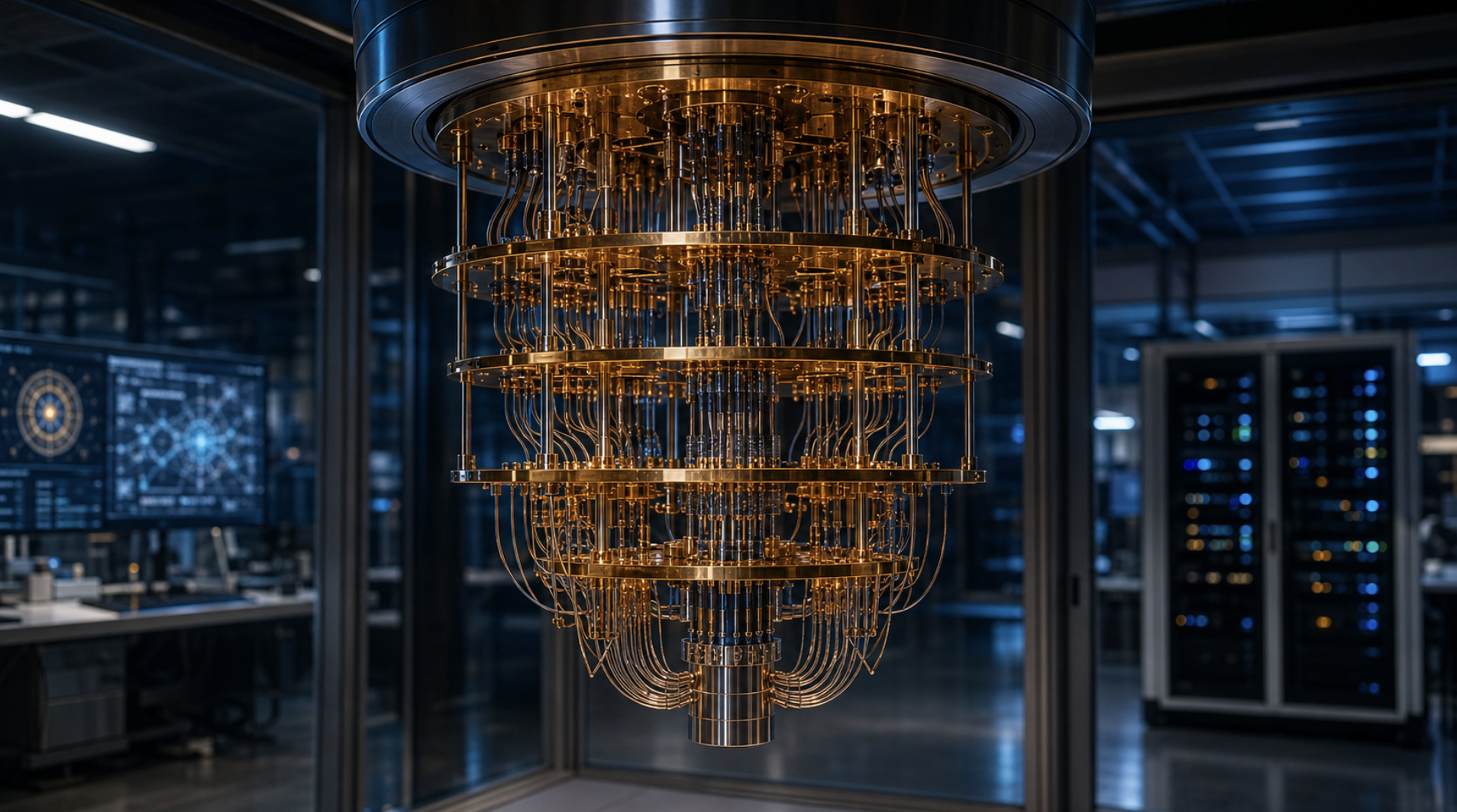
For all the promise, quantum computing faces obstacles so severe that the timeline for practical, broad usefulness is measured in years and probably decades, not months. The central difficulty is that qubits are extraordinarily fragile. The delicate quantum states that give the technology its power are easily disturbed by the slightest interference — heat, vibration, stray electromagnetic noise — causing them to lose their quantum behaviour in a process called decoherence. Keeping qubits stable long enough to compute requires isolating them in extreme conditions, often near absolute zero, and even then they remain error-prone.
This fragility leads to the field's defining challenge: error correction. Because individual qubits are so unreliable, building a genuinely useful quantum computer requires combining many physical qubits into fewer stable, error-corrected logical ones, which means the number of physical qubits needed for practical work is vastly larger than current machines provide. Progress is real and continuing, but the gap between today's experimental devices and a quantum computer capable of solving practically important problems reliably is enormous, and closing it depends on hard, unglamorous advances in physics and engineering rather than on a single breakthrough. This is why sober voices in the field consistently push practical timelines far beyond what the most excited coverage implies.
Holding two truths at once
The honest way to think about quantum computing is to hold two truths together, resisting both the hype and the dismissal. It is genuinely revolutionary for a specific set of problems, with the potential to transform areas of science and to eventually force a rethinking of certain kinds of security — a real and important technology, not a fantasy. At the same time, it is narrow, not a replacement for classical computing; and it is difficult and distant, held back by fragility and the immense challenge of error correction, with practical broad usefulness still years away.
Believing only the first truth produces the breathless overstatement that quantum computing will imminently upend everything. Believing only the second produces the cynical dismissal that it is all hype and will never matter. Neither is accurate. The technology is a specialised, powerful, and slowly maturing tool that will matter enormously for particular purposes while leaving everyday computing untouched. Approaching it with that calibrated understanding — impressed but not credulous, patient but not dismissive — is the way to make sense of a field where the reality is more interesting, and more constrained, than either the enthusiasts or the skeptics suggest.
Conclusion
Quantum computing is real, remarkable, and almost universally misunderstood. It is not a faster classical computer but a fundamentally different machine, built on the strange principles of superposition and entanglement, and useful only for a narrow class of problems with the right structure — simulating nature, certain optimisations, and specific tasks including the eventual threat to some encryption. Its power is constrained by the fact that quantum states collapse when measured and, above all, by the extreme fragility of qubits, which makes error correction the central obstacle and pushes practical, broad usefulness years or decades into the future. The sober view holds both its genuine promise and its real limits at once. Stripped of the hype, quantum computing is neither the imminent revolution nor the empty buzzword it is often made out to be, but a specialised and slowly advancing technology whose true significance, for the specific things it can do, is worth understanding clearly rather than either fearing or dismissing.