
The comforting illusion of permanence
The belief that digital equals durable comes from everyday experience. Files do not visibly age. A document opened today looks identical to the one saved a year ago, with none of the fading or wear that betrays a physical object's mortality. From this we infer that a digital file, unlike a book, simply persists — that it has escaped decay altogether. It is an easy inference, and it is exactly the trap.
The reality is that digital preservation is an active, ongoing effort, not a one-time act of saving. Left entirely alone, digital information does not endure; it degrades, becomes unreadable, or vanishes, through a set of failure modes that are invisible precisely because they do not announce themselves the way a torn page does. Paper announces its decline; a file gives no warning until the day it will not open. The permanence of the digital is a surface impression, and beneath it sit several distinct threats that a serious preservation practice has to fight continuously.
Bit rot and the decay of storage
The most literal threat is the physical fragility of storage itself, often called bit rot. The media on which digital information lives — hard drives, solid-state drives, discs, tapes — do not last forever. They degrade over time, and as they do, the actual bits recorded on them can flip or fade, silently corrupting the files they hold. A drive that worked perfectly can, years later, return a photograph riddled with errors or a document that no longer opens, not because anyone touched it but because the medium itself aged.
This decay is insidious because it is invisible and gradual. Unlike a dropped and shattered hard drive, bit rot leaves no obvious sign until you try to read the data and find it damaged. Preservation practice answers this threat not by trusting any single copy but through redundancy and vigilance: keeping multiple copies across different media and locations, and — crucially — actively checking those copies over time to detect corruption and repair or replace failing media before the damage spreads. The discipline is one of constant renewal, migrating data onto fresh storage on a schedule rather than assuming yesterday's drive will still be readable tomorrow. Preservation is less a vault than a garden that must be continually tended.
Format obsolescence and unreadable files
Even if the bits survive perfectly, a second threat can render them useless: the file format itself can become obsolete. A digital file is only meaningful if you have software capable of interpreting it, and software does not stand still. Formats fall out of use, the programs that once read them are discontinued, and over enough time a perfectly intact file can become an unreadable puzzle — the data all present, but no tool left that understands how to turn it back into a document, an image, or a sound.
This is a genuinely different problem from bit rot, and it requires a different answer. Preservation guards against obsolescence in two main ways. One is migration: periodically converting files from older formats into current, well-supported ones, so the information keeps moving forward onto formats that today's software can read. The other is favouring open, well-documented, widely-supported formats in the first place, since these are far less likely to become orphaned than proprietary or obscure ones. Choosing durable formats and migrating deliberately are core preservation strategies precisely because a file you cannot open is, in practice, a file you have lost — even though every bit of it remains.
Link rot and the disappearing web
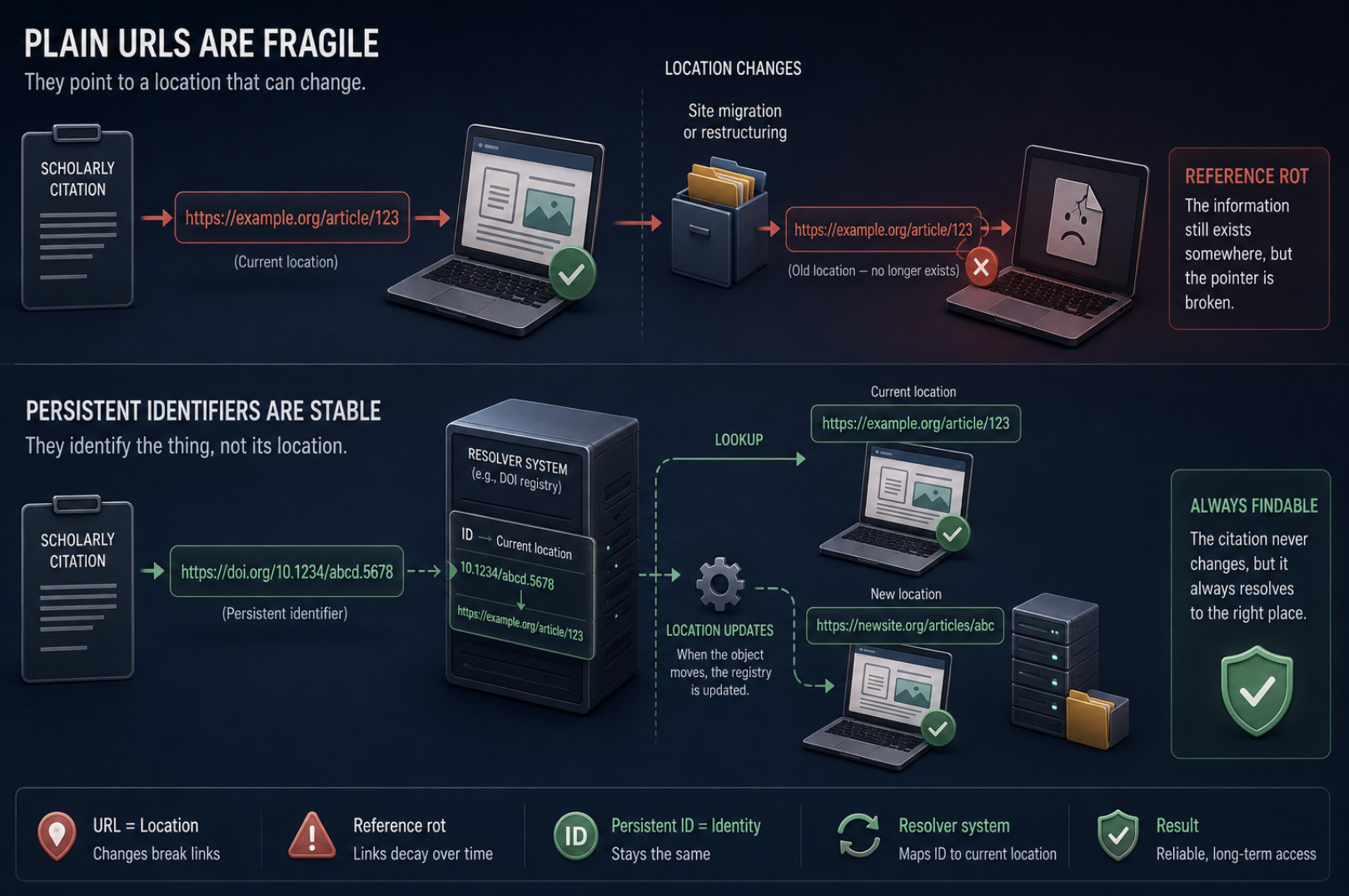
The third great threat is specific to the networked world, and it is one this community feels acutely: the disappearance of things the record points to. Online, information constantly moves or vanishes — pages are taken down, servers decommissioned, addresses changed — so that references and links quietly break, pointing at nothing. This link rot is a serious problem for the scholarly and cultural record, where a citation to a source that has evaporated undermines the whole chain of knowledge. It is the reason the community has invested so heavily in stable, persistent references, a subject we examined in the persistent identifiers holding digital scholarship together.
The response to link rot combines two efforts. Persistent identifiers give a resource a stable name that keeps pointing to it even as its web address changes, so the reference survives the churn of the live web. And systematic web archiving — capturing and storing copies of web content — preserves material that would otherwise simply disappear when a site goes dark. Together they fight the tendency of the online record to erase itself, ensuring that what was cited, published, or relied upon remains findable long after the original page has gone. Much of this preservation work also runs up against the physical realities of the infrastructure it depends on, a tension we explored in the data centers quietly straining the world's power grids.
An active commitment, not a saved file
Pull these threats together and a clear picture emerges of what digital preservation actually is. It is not the act of saving a file and walking away; it is an ongoing commitment to keep information alive against decay, obsolescence, and disappearance — refreshing storage, migrating formats, and maintaining stable references, indefinitely. The record does not preserve itself. It is preserved by institutions and people who treat it as a living responsibility rather than a finished task, doing quiet, continuous work so that the knowledge of today remains usable decades from now.
This is why digital preservation sits at the heart of what libraries, archives, and this field are for. The stakes are nothing less than whether the intellectual and cultural record of the digital age survives, or whether vast portions of it silently rot, orphan, and vanish while everyone assumes it is safe. The comforting illusion of digital permanence is precisely what makes the work so urgent: because the danger is invisible, it is easy to neglect until the loss is irreversible. The long fight against bit rot, obsolescence, and link rot is, in the end, a fight to make sure the future can still read the present — and it is a fight that has to be won over and over, one migration and one checked copy at a time.
Frequently asked questions
What is digital preservation? Digital preservation is the active, ongoing effort to keep digital information usable over long periods, guarding it against physical decay of storage, format obsolescence, and the disappearance of online resources. It is not a one-time act of saving a file but a continuous commitment involving redundant copies, format migration, and stable references.
What is bit rot? Bit rot is the gradual, often invisible degradation of digital storage media. Over time, hard drives, discs and other media age, and the bits recorded on them can flip or fade, silently corrupting files. A drive that once worked can later return damaged or unreadable data, which is why preservation relies on multiple copies and regular integrity checks.
Why do old digital files become unreadable even if undamaged? Because file formats can become obsolete. A file is only meaningful if software can interpret it, and formats fall out of use as the programs that read them are discontinued. Preservation counters this by migrating files to current, well-supported formats and favouring open, widely-supported formats that are less likely to be orphaned.